Compute footprint
Virtual machines and host counts.
Rapid Discovery provides a fact-based quantity baseline to support early cost indication and migration decisions in the Assess phase.
Rapid Discovery provides a fast, automated baseline of the current environment across on-premises and cloud landscapes. The focus is on quantifying the existing IT portfolio in a short time window, so teams can make early migration and commercial decisions with confidence.
At this stage, quantity and distribution matter more than deep application relationships.
Rapid Discovery builds an initial inventory of infrastructure and platform assets, including:
Compute footprint
Storage baseline
OS landscape
Kubernetes baseline
Database inventory
These metrics create the first fact-based view of migration scope.
The output of Rapid Discovery is a core input for:
This allows program stakeholders to align on financial direction and technical baseline before detailed planning starts.
Rapid Discovery is intentionally not a full application-level analysis. It does not include deep interviews with every application owner and does not aim to fully map all runtime dependencies.
That depth is covered in the subsequent Discovery phase, where infrastructure exports are enriched with targeted assessments and owner input to build a complete application picture.
Typical input sources include exports such as spreadsheets or similar inventory files from existing environments. This phase can be accelerated with AI-assisted tooling that extracts the required baseline metrics from uploaded datasets.
Rapid Discovery therefore acts as a prerequisite for structured cost indication and for shaping a realistic target environment strategy.
The following diagram shows why Rapid Discovery is performed: raw source data is processed by tooling into a decision-ready baseline that supports early price indication and initial target sizing.
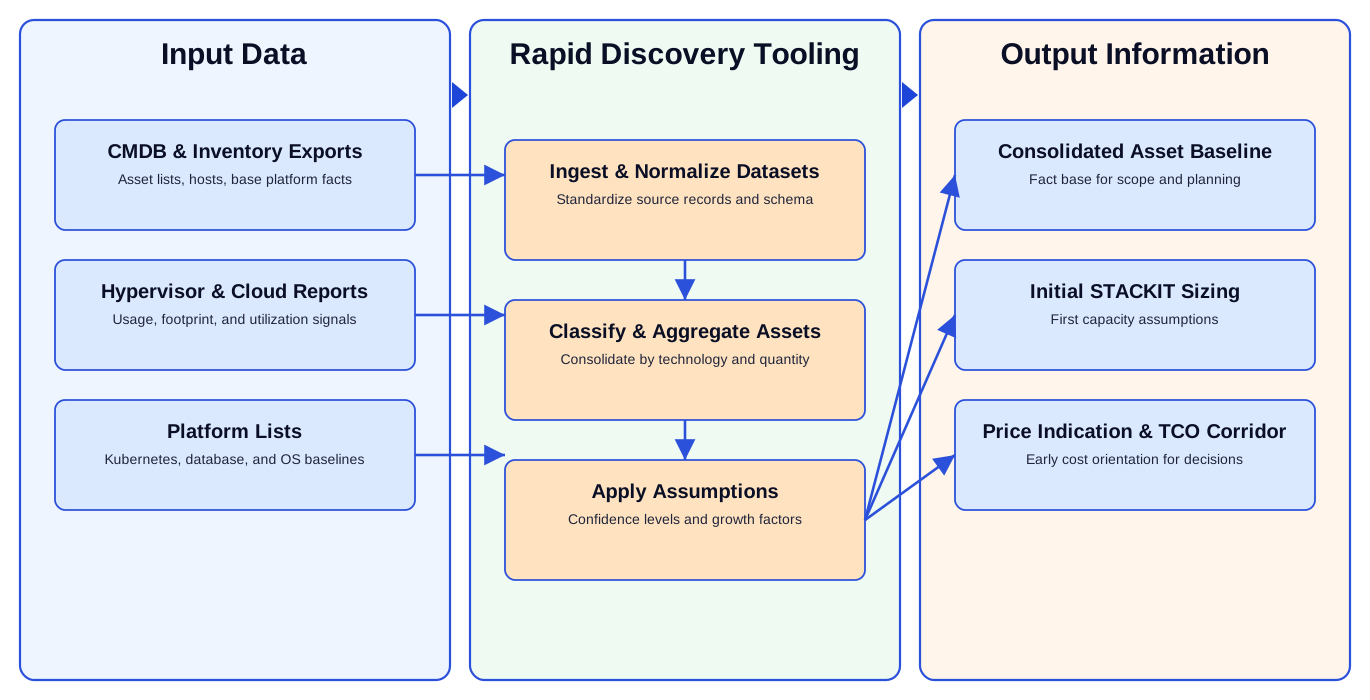
A robust Rapid Discovery typically follows a clear sequence:
The objective is not a perfect target architecture. The objective is a reliable starting point with enough accuracy for early decisions.
Result quality depends heavily on source quality. Typical issues include duplicates, outdated entries, inconsistent naming, and missing performance data.
Recommended practice for this phase:
This keeps cost indications traceable and allows focused refinement in the subsequent Discovery phase.
Rapid Discovery provides the volume baseline for early cost modeling. Captured assets are translated into STACKIT-relevant consumption dimensions, for example:
Combined with operating assumptions (runtime profile, availability targets, growth trajectory), this produces a solid first price indication and an initial TCO corridor.
At the end of Rapid Discovery, the following outputs should be available at a minimum:
Consolidated asset baseline
Quantities per technology domain are consolidated in one baseline.
Meaningful segmentation
Assets are segmented by criticality, environment, and modernization potential.
Traceable assumptions
Assumptions and identified data gaps are documented transparently.
Initial cost indication
Cost ranges and primary drivers are available for early planning.
Prioritized candidates
A prioritized list for deeper Discovery activities is available.
These outputs establish the working baseline for architecture, planning, and governance in the next Assess steps.
Common Rapid Discovery risks include over-simplified categorization, incomplete source systems, or overestimating data maturity.
Proven countermeasures:
This keeps the phase fast while preserving decision quality.
The handover point is reached when quantities, technology classes, and primary cost levers are sufficiently visible and open questions are clearly documented.
In Discovery, these open items are addressed through targeted owner interviews, deeper assessments, and dependency/compliance/operations analysis to build the full application-level picture.